



I first loved the use of the frame tale while reading modern literature such as The Saragasso Manuscript. I had always loved structures like Chinese puzzle boxes or palindromes, so the idea of stories within stories was a natural affinity for me.
Then I delved into The Thousand and One Nights. Here was a grandmother of the frame tale form: Scheherazade kicks it off with her own frame tale, then once she starts telling stories (or parts of stories) to the King every night, her frame tale must interrupt the story she’s telling so she’ll live another day to finish and not be beheaded! Many of the tales she tells are themselves frame tales, with one character catching up another character with his history, or an epic history containing many legends inside of it, or a set of fables having a frame around it, like a Vizier educating a King.
From Campfire to Isnad

As I researched the origin of the Nights, I learned that the frame tale is a favorite device in Arabic literature. Its origin may be around the desert campfire, when Bedouins traded stories and interrupted each other with variations or improvements upon one version or another.
There was an ironic supplement to the frame tale with the advent of Islam. At first, fiction was banned, considered lies: only stories verified through Mohammed’s voice or from the Bible were acceptable. If someone claimed to have a story about Mohammed and his family, or a wise saying from them, the teller had to verify the truth of the statement with an isnad, a frame declaring the source of the anecdote. “Mohammed’s cousin told my best friend that Mohammed said the following…” The isnad was the original framing device for the stories and anthologies that were eventually sanctioned by Islam.
There were many, many story anthologies in Arabic literature, but these were preceded by those from India, China, Persia, and even Western cultures. A frequent device to tie folk tales together in a compendium was the frame tale. The ghoul who sat on the Prince’s shoulder demanding stories on pain of death; the wise counselor who instructed his court in legal and moral matters by telling animal fables.
My AHA Moment!
So there I was, driving on the Garden State Parkway to play a dance class in Princeton, thinking about my idea for a novel where people recall their past lives. Suddenly The Thousand and One Nights popped into my head. What better way to accumulate past life tales into a karmic history than use the frame tale structure. Every chapter someone would recount one of their past lives. The frame tale would move from the present into the past and back out again every chapter. A perfect function for a frame tale.
Since the Nights suggested this form, I began my research and fell in love with the history of the Nights. No single edition of the book is an authentic one, and many of them are considered forgeries. What a dramatic history! My research bonded me to the Scheherazade legend as well, since that is the frame tale of the Nights. The characters of that story suggested the group of souls who would be remembering the past lives – the qaraq was born. The qaraq: the actors in the present day frame tale, the incarnations in the past life tales, and the set of archetypes based on the Scheherazade characters.
The present/past structure and modern Scheherazade frame tale was my no-brainer use of the frame tale device for the 1001, The Reincarnation Chronicles fantasy series. But I loved the frame tale, loved the variations it embodies in the Nights. Stories within stories, interruptions upon interruptions. There is a delight and surprise when you open the next Chinese box or Russian doll and find a smaller version inside. I was delighted and surprised by the infinite uses I could make of the frame tale.
Deeper into the Chinese Boxes
First, I extended the back and forth between present and past. The present day qaraqis often interrupt a past life tale with a question or a comment, clarify something, then return to the past. I went further and interrupted a past life story with a continuing set of events in the present (an afternoon of shopping in a light trance); or a present day event was interrupted insistently by a past life memory (someone’s regression during a funeral).
Then there are literary criss-crosses within the frame. Two qaraqis have interconnected memories and the past life stories duel with each other. Each qaraqi has their own literary style as the voice of their past life tale: fairy tale, second person confession, stream of thought. Sahara Fleming, my modern day Scheherazade, has the frame tale device as her very own style; her tales come in segments.
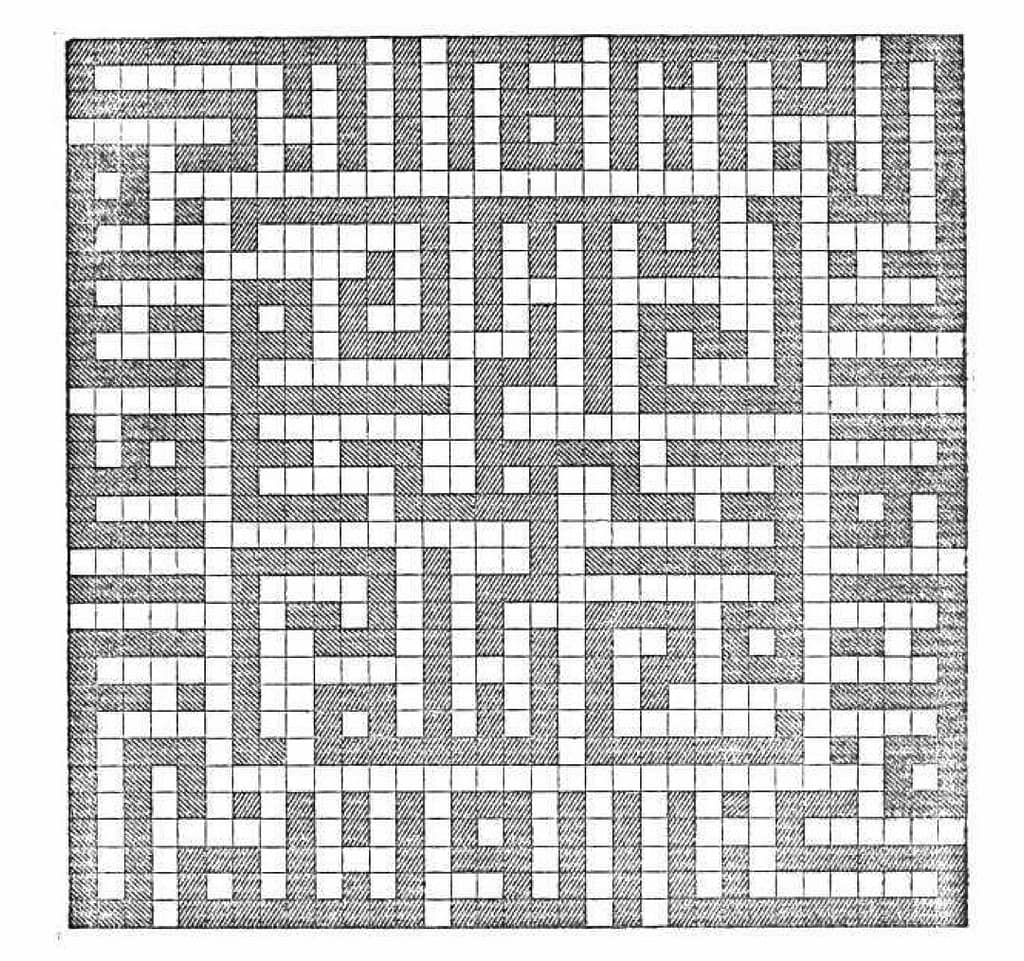
Frontispiece of Burton’s edition of the 1001 Nights. Talk about frames within frames!
On a larger level, some of the books in the series have their own frame tale structure. For example in Book Six, The Qaraq and the Family Way, the qaraq is divided into five duos, each with their own sections in the novel. Three duos start the novel in three locations, Sahara and Bax in Peru, Diana and Naji in Oxford, and Zack and Porcy in Chicago. In the second half of the book, these three duos re-appear in reverse order. In the center of this palindrome, a fourth duo, Amar and Ooma, have their section in Israel.
That’s seven sections altogether. But in between each of these sections there are scenes featuring the ailing Verle being nursed by Cachay, with the intervention of their spirit guide Elvi. That makes many inner frame tales nested into one another to form a more complex frame tale structure.
Frame Tales Within Frame Tales
If there’s anything I love more than frame tales it’s inner frame tales. So not just a story within a story, but a set of stories nested within a set of stories. This idea manifests as my biggest use of the frame tale in The Reincarnation Chronicles. It’s one of the eleven hidden structures in the series.
In Book One, I begin simply by inserting several inner frame tales that only last four chapters, and four stories. In Book Two, I expand to 8-story frame tales, and Book Three sees 16-story frame tales. Book Four has two 32-story inner frame tales, and Book Five has one 64-story inner frame, broken up into groups of 16 and 32 chapter sections.
The next mathematical development of this scheme would be a 128-story inner frame tale, but it must straddle Book Six and Seven to fit into the series. For the final 256- story structure, it would have to straddle Books Eight to Eleven. But I’m deciding whether to try and accomplish this insanity or go a different route: decumulate the frame tales down from 64 to 32 and back to 4-story frame tales by Book Eleven.
Part of this decision is about the why of each inner frame. One of the 8-story frames is about Naji telling the qaraq the Draill U – alien arts conservatory tales at a Halloween party. One 32-story frame is the qaraq’s Exploration of the globe in the Renaissance. But I’m unsure of the concept holding together a 256-story tale. I’ll let you know when I do…
Infinite Uses…
At this point, you’re wondering: why is he jumping through all these hoops with this frame tale business? Which begs the question: what does it all mean? I’ve mentioned the delight and surprise found in frame tales: oh, now this character’s telling a story; oh, we’re back in the present after that long flashback, right! And early Muslims had the meaning of verification of the truth with their framing devices.

There’s also the sense of depth a frame tale offers. Many frame tale anthologies just hold the stories together; not much meaning there, but the holding itself gives us a stability, a reason these tales are all together, a feeling of content when we return to the frame each time. If a frame tale has a theme or larger action, like Porcy reviving her status within the qaraq, then this frame tale can explore different answers and go deeper and deeper into the problem.
Finally, a frame tale can take us deeper and deeper into stories within stories within stories. The modern literature use of frames sometimes plays with this journey into a maze of stories. In The Saragasso Manuscript, there are times when we are totally lost within the inner frames, just as the characters get lost in the desert or in their purpose in life. The modern frame tale has the option to get us lost in mounting stories and never bring us back to the original source of the frame tale. This labyrinth reflects the modern idea of how small and insignificant we are in the cosmos.
So there is a huge range of possibility with the use and appreciation of the frame tale, both ancient and modern. I hope you see the possibilities, including some of the ones I have exploited in The Reincarnation Chronicles. I love frame tales, and I have loved working with them in deeper and deeper ways in the fantasy series.
To explore more about literary structures, the Nights, or reincarnation tales, join The Maqaraqan, the newsletter of The Reincarnation Chronicles (see footer below).